
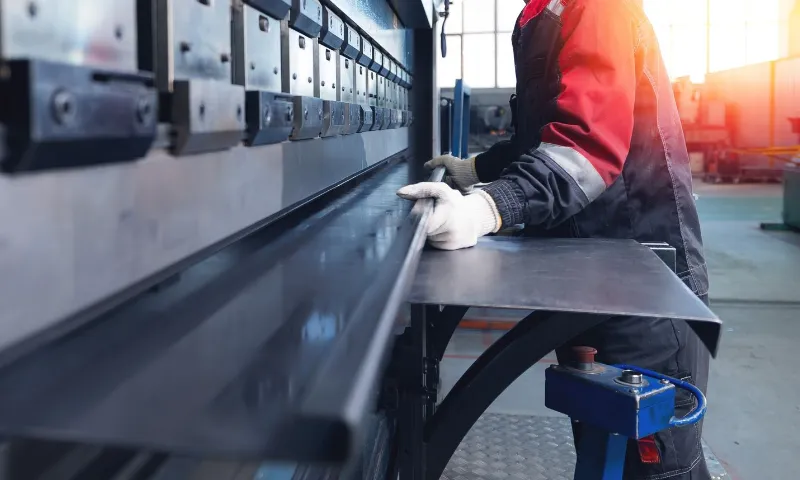
Bending, often referred to as profile bending, is a fabrication process used to shape metal sections into curves, angles, or custom geometries.
Unlike cutting processes that remove material, bending reshapes the metal by applying controlled force using specialised machinery.
This allows materials such as beams, tubes, and sheets to be formed into precise shapes while maintaining their structural integrity.
Shaping Metal Profiles for Structural and Architectural Applications
Profile bending allows metal components to be formed into smooth curves or angled shapes without compromising the strength of the material. Modern bending machines use controlled pressure and positioning to ensure accurate, repeatable results across different projects.
Because the process does not remove material, the structural continuity of the metal is maintained, which is important for load-bearing components and engineered assemblies.
Bending is widely used across fabrication projects that require curved structures, custom profiles, or architectural metal elements.
Why Bending Is Used in Fabrication
Creates Complex Shapes
Bending can produce arcs, curves, spirals, and other custom geometries.
Maintains Material Strength
Because material is reshaped rather than removed, the strength and continuity of the metal are preserved.
Efficient Production
Bending reduces the need for additional welding or joining in some assemblies.
Precision Results
Modern CNC bending systems provide accurate and repeatable results.
Architectural Flexibility
Smooth curved profiles are often used in architectural and structural applications.
Materials Suitable for Bending
Bending can be applied to a wide range of metals including steel, stainless steel, aluminium, copper, and brass. Sheet metal and extruded profiles are commonly bent to create structural components or custom fabrication elements.
Different materials and thicknesses require specific bending techniques to achieve accurate results while maintaining material integrity.
This flexibility makes bending a key process in modern metal fabrication.
Industries That Use Bending
Bending is widely used across industries that require shaped metal components. In construction and structural fabrication, bent beams, arches, and handrails are commonly used in building and infrastructure projects.
Architectural fabrication often uses bending to create curved facades, decorative elements, and custom structures. The process is also used in automotive and aerospace manufacturing to shape chassis components and structural frames.
Furniture manufacturing, industrial equipment production, and signage fabrication also rely on bending to produce shaped metal components.
Need custom metal profiles or curved structural components?
Speak with the team about profile bending and fabrication capabilities for your next project.
Expert engineering solutions
We specialise in solving engineering challenges of all varieties, backed by traditional customer service. Our expert team delivers customised solutions spanning specification and functional design, estimate and risk assessment, drafting, fabrication, installation, project management, decommission and relocation, repair and maintenance. Whatever you need, consider it done.


Our clients


© Copyright DARK KNIGHT ENGINEERING 2026 All rights reserved. | Website by Brilliant Digital.